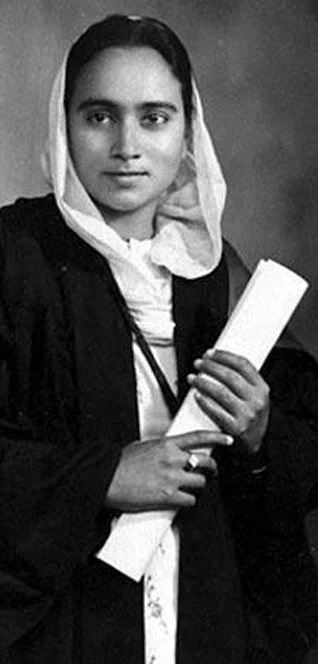
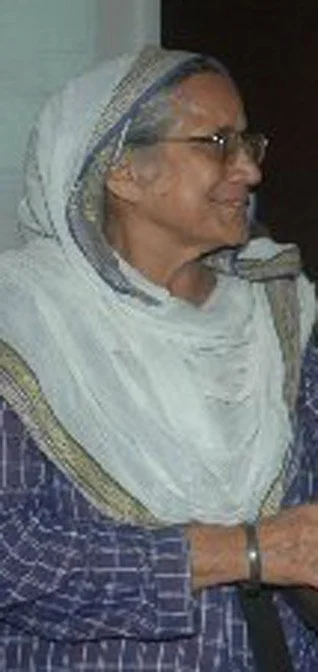
Madam Vice-Chancellor: Inderjit Kaur
First Woman Vice-Chancellor in North India
“Are you a feminist?” someone once asked her.
“Not the bra-burning kind,” she replied with characteristic wit.
Inderjit Kaur combined grace with steel, warmth with authority. Charming and courteous, she carried eight decades of experience lightly but behind the gentle smile stood a formidable academic, administrator and reformer who would go on to hold two of the most prestigious positions in India.
Though widely recognised as the first woman Vice-Chancellor in North India, she remained modest:
“There may have been someone in the South but I do know I was the only woman VC in North India.”
After serving as Vice-Chancellor, she went on to become Chairperson of the Staff Selection Commission, New Delhi - one of India’s premier national recruiting bodies.
Early Life and Education
Inderjit Kaur was born on September 1, 1923, to Colonel Sher Singh - a progressive and unconventional man who celebrated the birth of his daughter with the same joy others reserved for sons. His career took the family across remote regions including the North West Frontier Province and Peshawar, instilling resilience and adaptability early in her life.
She studied at Victoria Girls School, Patiala and later moved to Lahore for higher education - an extraordinary step at a time when few women pursued advanced studies. She earned:
B.T. from R.B. Sohan Lal Training College, Lahore
M.A. in Philosophy from Government College, Lahore
She was among the first women from Patiala to receive such advanced education. Even before her examination results were declared, she began teaching at Victoria Girls Intermediate College in December 1946.
Early Life and Education
The Partition of India brought an influx of refugees into Punjab. Inderjit Kaur responded not as an observer but as an organiser and activist.
She helped establish the Mata Sahib Kaur Dal, serving as its Secretary. The organisation:
Rehabilitated over 400 refugee families in Patiala
Collected and distributed food and clothing
Sent four truckloads of relief material to Baramulla, Kashmir
Established the Mata Sahib Kaur Dal School for refugee children
Organised self-defence training for women, in which she herself participated, topping the shooting competition
Her leadership during this turbulent period reflected courage, compassion and action.
Academic Leadership and Institutional Growth
She was among the first batch of students to complete a Master’s degree in Punjabi. From 1950–1953, she served as the only woman on the governing council of Khalsa College, Amritsar.
Her academic journey included:
Professor of Education, State College of Education, Patiala
Faculty member, Basic Training College, Chandigarh (1958–1967)
Principal, Government College for Women, Patiala (1972)
As Principal, she expanded the college significantly:
Added a science wing
Increased student enrolment substantially
Revived co-curricular excellence
Brought the gidda troupe to the Republic Day Parade, giving Punjabi folk culture national exposure
She later served as Principal of Government College for Women, Amritsar, where she focused on strengthening academic standards.
Vice-Chancellor of Punjabi University, Patiala (1975–1977)
In 1975, Inderjit Kaur became Vice-Chancellor of Punjabi University, Patiala.
On the eve of assuming office, she encountered protesting students. When one student referred to “the king’s party,” she responded calmly:
“How can there be a king’s party when there is no king?”
The humour defused tension. It was a glimpse of her leadership style - firm, intelligent and human.
During her tenure:
Publication output increased significantly
Ph.D. completions rose
Academic productivity strengthened
Her administrative effectiveness drew national attention. At a Vice-Chancellors’ conference, the Vice-Chancellor of the University of Madras, Malcolm Adiseshiah, publicly expressed surprise at how Punjabi University was publishing more books than his institution.
She was known for her intellectual integrity. When questioned for allotting a larger house to Professor L.M. Joshi, she replied:
“I have given the house to his books.”
International Representation
As Vice-Chancellor, she represented India globally:
Conference of the Association of Commonwealth Universities, Wellington, New Zealand
International Conference of Executive Heads of Universities, Boston, USA where she was among only three women university heads in the world
Delivered the 1976 Guru Nanak Lecture at the University of Hull, UK
Lectured at the School of Oriental Studies, London
She balanced global representation with unwavering academic focus at home.
She resigned in 1977 due to political differences with the incoming government - a decision reflecting principle over position.
Chairperson, Staff Selection Commission (1980–1985)
In 1980, she was appointed Chairperson of the Staff Selection Commission (SSC), New Delhi.
Initially welcomed with sweets by hopeful staff, she soon proved that kindness did not exclude discipline. She was firm, efficient and reform-oriented.
Her contributions included:
Streamlining examination processes
Enforcing strict schedules for results
Establishing objective evaluation norms still in use
Managing examinations with over 670,000 applicants (1983 data)
Filling more than 20,000 vacancies across India
Travelling extensively, often 20 days a month to oversee operations
She championed objective-type examinations and delivered keynote addresses on evaluation reform.
Legacy
After completing her term in 1985, she returned to Chandigarh. Having shaped institutions, reformed systems and broken barriers, she chose a quieter life devoted to family and personal pursuits.
Inderjit Kaur’s legacy is not merely that she was “the first woman” in a position but that she strengthened every institution she touched.
Grace without weakness. Authority without arrogance. Service without spectacle.
A true role model for generations to come.
(Courtesy- Nishaan. Edited for edusikh.com)